Full white-labelTime → invoice4.7★ avg. rating
Custom & White-Label PM Platforms
Project Management Software Development
Custom platforms for agencies that have outgrown per-seat tools — your workflow, your branding on your own domains, tracked time that becomes an invoice, and multi-tenancy if you want to resell it. Unlimited seats, no license renewal.
A
S
C
D
yourbrand.com · Client workspace
In progress
Review
Billable
18.5 approved hours → draft invoice #2210 · $2,775
Margin41%
Utilization78%
BrandingYours
Multi-tenant
Your domain
Auto-invoicing
White-Label ModeCustom DomainsMulti-TenantKanban BoardsTime TrackingAuto-InvoicingClient PortalsResource PlanningProfitability ReportingReal-Time CollaborationRole-Based AccessAPI & WebhooksWhite-Label ModeCustom DomainsMulti-TenantKanban BoardsTime TrackingAuto-InvoicingClient PortalsResource PlanningProfitability ReportingReal-Time CollaborationRole-Based AccessAPI & Webhooks
16 wks
Typical build to launch
Unlimited
Seats, at no extra cost
Multi-tenant
Resell under your own brand
4.7★
Average client rating
Straight Answer
When building beats buying
Most teams should use an off-the-shelf tool. Asana, Linear, and ClickUp are genuinely good and genuinely cheap at small scale, and we will say so rather than sell you a build you do not need.
Three situations change that answer. If one of them applies to you, the maths tends to be decisive rather than marginal — and we will show you the numbers before you commit to anything.
Get a build-vs-buy costing No obligation, and we will tell you to buy if you should
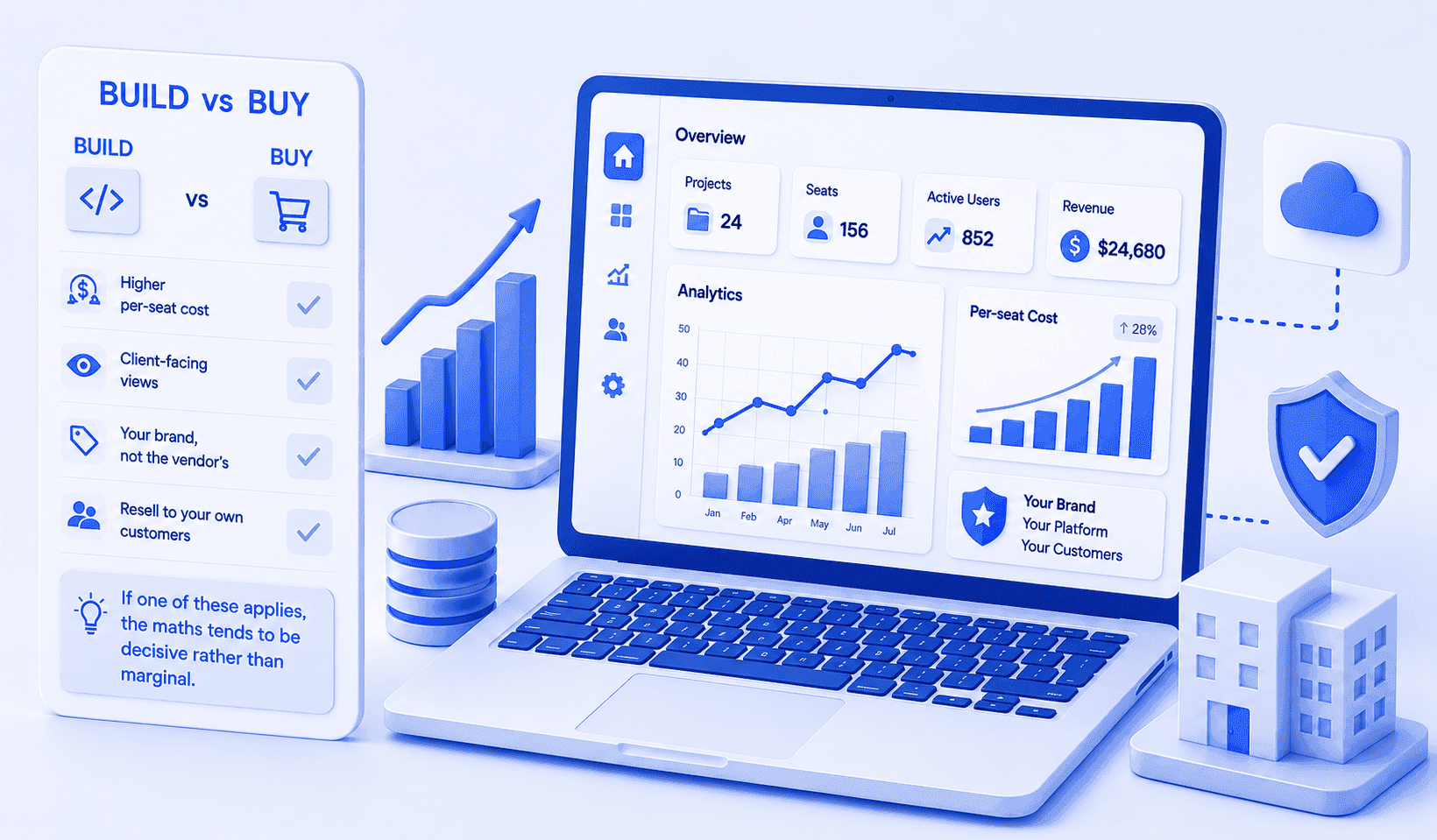
Licenses cost more than a build
Per-seat fees across every tool have passed what a one-off build would cost, and they rise with every hire.
Clients see your brand, not a vendor’s
You need client-facing views on your own domain, with your logo — because the platform is part of what you sell.
You want to resell the platform
Multi-tenant delivery under your name turns an internal cost center into a line of recurring revenue.
Build time
16–20 weeks
Team
4–5 engineers
Stack
Next.js · Node · PostgreSQL · Redis
Tenancy
Single or multi-tenant
Branding
Full white-label, custom domains
Why agencies rebuild
Four reasons teams outgrow SaaS
Per-seat pricing punishes growth
Every hire adds a license, on every tool. An agency of forty pays more for project management each year than a competent build would have cost once — and owns nothing at the end of it.
Fixed build cost, unlimited internal and client seats forever
Four tools, none of them talking
Boards in one product, time tracking in another, invoices in a third, client updates over email. The reconciliation between them is somebody’s job, and it is a job that produces nothing.
One system where tracked time becomes an invoice without re-entry
You cannot put your brand on it
Client-facing views carry someone else’s logo. For an agency reselling delivery capability, that is a visible reminder that the platform is not yours — and it caps what you can charge for it.
Full white-label with your branding on custom client domains
You cannot see project profitability
Hours live in one system and rates in another, so nobody knows which projects actually make money until the quarter closes. By then the unprofitable retainer has run for three more months.
Live margin per project, per client, and per team member
What We Build
Delivery and billing in one system
Boards built to your workflow
Custom stages, swimlanes, dependencies, and automation rules that match how your team actually delivers — not a fixed template you bend your process around.
Custom stagesDependenciesAutomation
Time tracking that feeds billing
Timers and manual entries attach to tasks, carry a billable flag and a rate, and roll straight into invoicing. No CSV export, no monthly reconciliation ritual.
Task-levelBillable ratesApprovals
Automated invoicing
Draft invoices generated from approved time and fixed-fee milestones, with your templates, tax rules, and currencies, pushed into Xero or QuickBooks.
From tracked timeMulti-currencyAccounting sync
Client portals
Each client sees their own projects, progress, approvals, and files — and nothing else. Scoped access replaces the weekly status email permanently.
Scoped accessApprovalsFile sharing
Resource and capacity planning
Who is allocated where, who is over capacity next month, and what happens to the schedule if a project slips two weeks. Answers before the crunch, not after.
AllocationCapacityForecasting
Profitability reporting
Margin per project, per client, and per person, computed from real tracked hours against real rates. The report most agencies only assemble once a quarter, available daily.
Live marginUtilizationForecast vs actual
White-Label
A platform you can put your name on
Most tools offer a logo upload and call it white-label. If your client can see a vendor name in the URL, the login page, or the footer of a notification email, it is not.
Your logo, palette, and typography throughout
Client-facing views on your own custom domains
Per-tenant branding for agencies reselling to sub-clients
Branded transactional email from your domain
Configurable feature sets per tenant or plan tier
Isolated tenant data with shared infrastructure
Your own billing and subscription logic if you resell
No vendor branding anywhere, including login and error pages
If reselling is part of the plan, say so at the start. Multi-tenancy shapes the permission model and the data layer, and retrofitting it later costs considerably more than building it in from the beginning.
SaaS vs Custom
Per-seat subscription vs owning the platform
Cost model
Per seat, per month, rising with headcount
Fixed build, unlimited seats
Branding
Their product with your logo, sometimes
Entirely yours, custom domains
Workflow
Their stages, your compromises
Modeled on how you actually deliver
Billing link
Export hours, invoice elsewhere
Approved time becomes a draft invoice
Reselling
Against most terms of service
Multi-tenant, built for it
Data
Vendor-hosted, export on request
Your database, your cloud
How We Work
From four tools to one platform
Map delivery
How work moves from sold to delivered, who approves what, and how billing actually happens. Agencies differ far more here than they expect.
Model tenancy and rates
Single-tenant or multi-tenant, rate cards, billable rules, and branding scope get decided early — retrofitting multi-tenancy later is expensive.
Build in sprints
Boards, time tracking, invoicing, and client portals ship in parallel. Your team runs real projects in staging from around week eight.
Migrate and launch
Projects, clients, and historical time imported and reconciled, then a phased cutover team by team rather than a hard switch.
Why Ethersofts
Why agencies choose us to build it
White-label done properly
Custom domains, per-tenant theming, and branded email — not a logo slot in the corner of someone else’s product.
Time and money connected
The gap between tracked hours and issued invoices is where agency margin quietly disappears. We close it in the data model.
Multi-tenant from day one
If you plan to resell, tenancy has to be in the foundations. Bolting it on afterwards means rewriting the permission layer.
Profitability, not just activity
Most PM tools report on tasks completed. Agencies need margin per project, and that requires rates in the same system as hours.
Adoption is a design problem
A tool your team avoids is worse than the spreadsheet it replaced. We prototype with the people who will use it daily.
Yours to run and sell
Full source, your cloud, no license renewal. If you resell it, every rupee of that revenue is yours.
“Our ad spend was bleeding money. They rebuilt tracking from scratch, restructured campaigns, and tripled our ROAS in three months. First team that showed real before-and-after numbers.”
PS
Priya Sharma
Head of Growth · Zestify Commerce · Mumbai, India
FAQ
Project management software, answered
If your question isn't here, ask it. You'll get a real answer from an engineer within 24 hours — not a sales pitch.
For most teams you should not — those products are good and cheap at small scale. Building makes sense in three cases: per-seat costs have outgrown a one-off build, you need client-facing views under your own brand, or you want to resell the platform to your own customers. Outside those, off-the-shelf is the rational answer and we will tell you so.
Your logo, colors, and typography throughout, client-facing views served from your own domains, transactional email sent from your domain, and no vendor branding anywhere — including login and error pages. For multi-tenant deployments each tenant can carry its own branding, which is what makes reselling viable.
Yes, and that is a common reason agencies commission this build. Multi-tenant architecture, per-tenant branding, configurable feature tiers, and your own subscription billing are all supported. Because you own the source there is no license restricting how you commercialize it.
Time entries attach to tasks and carry a billable flag and a rate from the project rate card. Once approved, they roll into a draft invoice along with any fixed-fee milestones, formatted with your template and tax rules. The draft syncs to Xero or QuickBooks for final issue, so nothing is keyed twice.
Sixteen to twenty weeks for boards, time tracking, invoicing, client portals, resource planning, and reporting. Multi-tenant white-label adds roughly three to four weeks over a single-tenant build. Your team can run real projects in staging from around week eight.
Yes. We import projects, tasks, clients, and historical time entries from Asana, Monday, Jira, ClickUp, Trello, or a spreadsheet export, then reconcile the figures against your current reporting before cutover. History matters because your utilization and margin baselines depend on it.
The honest maths depends on headcount. Below roughly twenty-five seats, off-the-shelf is usually cheaper and you should stay there. Above that, and particularly if you want white-label or reselling, a fixed build typically pays back within two to three years and keeps paying after that. We will run the comparison with your real numbers before you commit.
Completely. It ships to your repository, deploys to your cloud accounts, and carries no license-back clause or revenue share. If you want to maintain it in-house afterwards we run a hand-over with your engineers and provide the runbooks.
Paying per seat for four tools?Let's Build The Platform

Let's Build The Platform
You Actually Own
Send us your headcount and current tool spend. We'll run the build-versus-buy maths honestly — including telling you to stay put if that is the right answer.
Free consultation24-hour responseNDA on request