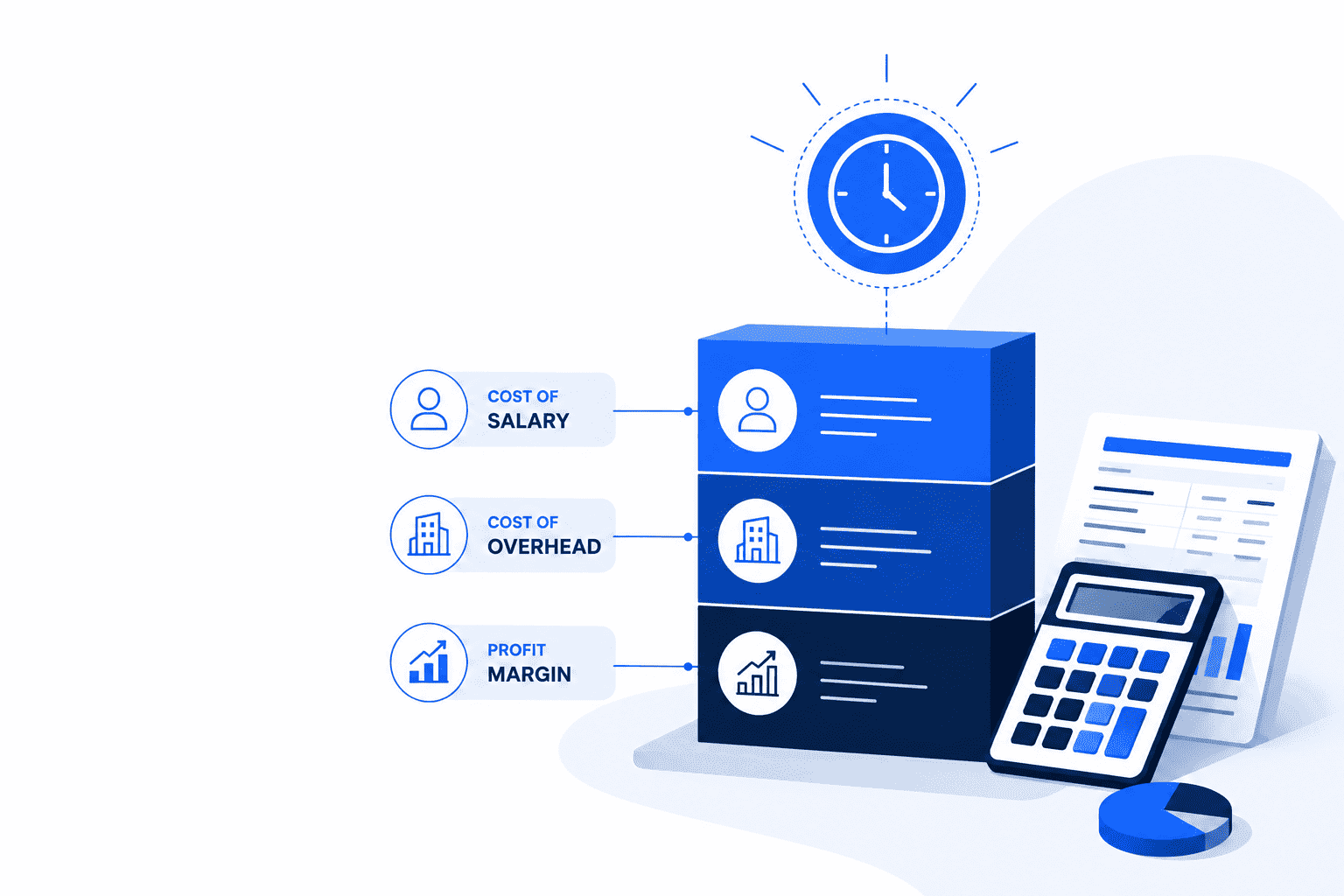
Short answer: the honest custom software development cost india range is ₹1,180 to ₹3,000 per hour (about $12–$32) for a competent mid-to-senior developer at an agency. Below is the arithmetic that produces those numbers, so you can check any quote you receive instead of trusting a range someone published without showing their work.
Why every quote you have seen is a range with no math behind it
Search this topic and you will find a dozen agency pages quoting “$15–$50 per hour” or “an MVP costs $20,000–$80,000”. None of them show how they arrived at the figure. The range is wide enough to be unfalsifiable and vague enough to cover whatever the agency wants to charge you.
A price you cannot verify is not information. So here is the model, built from published salary data rather than assertion. Every input is sourced and every assumption is stated. Change an assumption and the answer changes — that is the point.
Step 1: what a developer in India actually earns
Two independent datasets, both current as of mid-2026:
- Payscale reports an average annual salary of ₹716,462 for a Software Developer in India, from 2,101 profiles, updated 9 July 2026. The 10th–90th percentile band runs ₹289,000 to ₹2,000,000.
- Glassdoor puts median total pay at ₹785,000, with a range of ₹442,000 to ₹1,400,000.
The two agree closely enough to use. We will take ₹785,000 as the mid-level figure and ₹2,000,000 as the senior figure.
Step 2: what that developer costs the agency
Salary is not cost. An agency also pays employer contributions, health cover, equipment, office space, software licences, recruitment, the bench between projects, and the project managers and QA engineers who are not billed to you directly. It also has to make a margin or it stops existing.
Professional services firms typically apply a loaded-cost multiplier of 2.5x to 3x salary. This is a rule of thumb, not a published statistic — treat it as the assumption it is. We will use 2.7x.
An agency developer is also not billable every hour. A 2,080-hour year minus leave, public holidays, training and internal work leaves roughly 1,800 billable hours at good utilisation. Firms that assume more than that are either burning people out or quietly missing targets.
Step 3: the arithmetic
| Input | Mid-level | Senior |
|---|---|---|
| Annual salary | ₹785,000 | ₹2,000,000 |
| × loaded multiplier (2.7) | ₹2,119,500 | ₹5,400,000 |
| ÷ billable hours (1,800) | ₹1,178/hr | ₹3,000/hr |
| In USD (at ₹94.41) | $12.47/hr | $31.78/hr |
The exchange rate is the mid-market USD/INR rate of 94.41 on 3 September 2026. It moves; recompute before you sign anything.
So the widely quoted “$15–$50 per hour” is half right. The floor is real. The ceiling is inflated — $50 per hour implies a salary north of ₹3,000,000, which is Bengaluru product-company territory, not typical agency staffing.
What this means for a whole project
Multiply the blended rate by realistic hours. Assume a blended $18 per hour across a mixed team of mid and senior engineers:
| Scope | Engineering hours | Indicative cost |
|---|---|---|
| Focused MVP, one user role, no integrations | ~800 | ~$14,400 |
| Production SaaS, multi-role, 2–3 integrations | ~2,000 | ~$36,000 |
| Enterprise platform, compliance, migrations | ~5,000 | ~$90,000 |
These are engineering hours only. Design, project management and QA typically add 25–40 percent on top — and if a quote does not name them, ask where they went.
What actually drives the hours
The rate is the part everyone negotiates. The hours are the part that decides the bill. Five things move the hour count far more than anything else:
- Number of distinct user roles. Each role means its own permissions, its own screens and its own test matrix. Going from one role to three rarely triples the work, but it comfortably doubles it.
- Third-party integrations. Budget 40–120 hours per integration depending on the quality of the other side’s API. A documented REST API with sandbox credentials sits at the bottom of that band. A legacy SOAP endpoint with no test environment sits well above the top of it.
- Data migration. Consistently the most underestimated line item on any replacement project. If you are moving off an existing system, the cleaning and reconciliation of that data is often a larger job than the feature it feeds.
- Compliance requirements. HIPAA, SOC 2, GDPR or RBI requirements add audit trails, encryption, access controls and documentation. This is not a feature you can bolt on later without rework, and it belongs in the estimate from day one.
- How well the spec is written. The cheapest hour is the one nobody has to bill because the requirement was clear the first time.
Notice that only one of those five is a technology choice. The rest are decisions you make before any code is written — which is why the discovery phase pays for itself.
The four costs that are not in the quote
Most budget overruns on offshore projects are not caused by the hourly rate. They come from four places:
- Requirements churn. The single largest cost driver. A fixed-price contract against a vague spec converts every clarification into a change request. Pay for a discovery phase first; it is cheaper than paying for it in change requests.
- Timezone overlap. India is UTC+5:30. Against US Eastern that is a 9.5-hour gap. If your team needs daily synchronous decisions, you are buying either overtime or a one-day round trip on every blocked question.
- Handover and documentation. Frequently descoped to hit a number, then billed later when you need to hire in-house or switch vendors. Put it in the contract.
- Post-launch support. Budget 15–20 percent of build cost annually for maintenance, dependency updates and security patches. Software that is not maintained is a liability, not an asset.
How to tell a real quote from a made-up one
Send the same brief to three vendors and compare on these points, not on the total:
- Does the quote break down hours by role and phase, or is it one number?
- Are QA, design and project management priced explicitly?
- What happens to the price when the spec changes — is there a written change process?
- Who owns the code and the repository on day one?
- What are the handover deliverables if you leave?
A vendor quoting materially below the ₹1,180 per hour floor is doing one of three things: staffing juniors, assuming utilisation they cannot sustain, or planning to make the margin back on change requests. Any of those is worth knowing before you sign.
Custom software development cost india versus the US and Eastern Europe
Run the same model with local salary data and the picture is straightforward: India’s advantage is real and structural, driven by the salary input, not by cutting corners. The gap narrows once you account for timezone overhead and the extra communication cycles a distributed team needs — but on a well-specified project with a documented scope, it does not close.
The useful comparison is not rate against rate. It is total cost of a delivered outcome against the same. A US in-house team removes the timezone cost and the communication overhead, and pays for that with a salary input several times higher. An Eastern European team sits between the two on both axes, with the added advantage of overlapping working hours with Western Europe. India wins clearly on the salary input and loses some of that back on coordination — and how much it loses back is almost entirely a function of how well you specify the work.
Which is the same conclusion the hours section reached, from the other direction. If your requirements are stable, distance is cheap. If they are not, distance is expensive everywhere, and you should fix the requirements before you shop for a rate.
Frequently asked questions
Is fixed-price or time-and-materials better?
Fixed price works when the scope is genuinely fixed — a defined integration, a migration with a known schema. For anything exploratory, fixed price transfers risk to you as change-request pricing. Time and materials with a capped sprint budget is usually more honest.
How much should a discovery phase cost?
Typically 5–10 percent of the estimated build. It should produce a written specification, wireframes and a revised estimate you can hold the vendor to.
Does a lower hourly rate mean lower total cost?
No. Total cost is rate multiplied by hours, and unclear requirements inflate hours far faster than a rate discount reduces them. A $12 per hour team on a vague brief will cost more than a $25 per hour team on a clear one.
What about maintenance after launch?
Budget 15–20 percent of build cost per year. This covers dependency updates, security patches, hosting changes and small enhancements.
For a related decision earlier in the process, see custom software versus SaaS, and the rest of our writing in the Knowledge Hub.
Working out your own number
Take the model above, substitute the seniority mix your project actually needs, and you have a defensible budget before you talk to a single vendor. That is a better negotiating position than any published range.
Ethersofts builds custom software and AI systems from Mohali, Punjab. If you want the arithmetic run against your specific scope, see how we work and send us the brief — we will send back an hours breakdown by role and phase, not a single number.