Rules-based dispatchiOS + Android4.9★ on a past build
On-Demand & Service Booking Apps
Booking App Development Company
Customer app, provider app, and dispatch console — with a matching engine that decides who gets each job, live tracking that stops the "is he coming?" calls, and payments that settle on completion. Your platform, your margin.
H
S
B
W
Job #7741 · Deep clean · 2 hrs
Match time8s
Accept rate94%
PaymentCaptured
Live tracking
Verified providers
In-app payment
Service CatalogReal-Time AvailabilityProvider MatchingLive Job TrackingIn-App PaymentsRatings & ReviewsPush NotificationsRecurring BookingsDispatch ConsoleRoute OptimizationiOS & AndroidProvider AppService CatalogReal-Time AvailabilityProvider MatchingLive Job TrackingIn-App PaymentsRatings & ReviewsPush NotificationsRecurring BookingsDispatch ConsoleRoute OptimizationiOS & AndroidProvider App
12 wks
Typical build to launch
3 apps
Customer, provider, admin
iOS + Android
From one codebase
4.9★
Rating on a past build
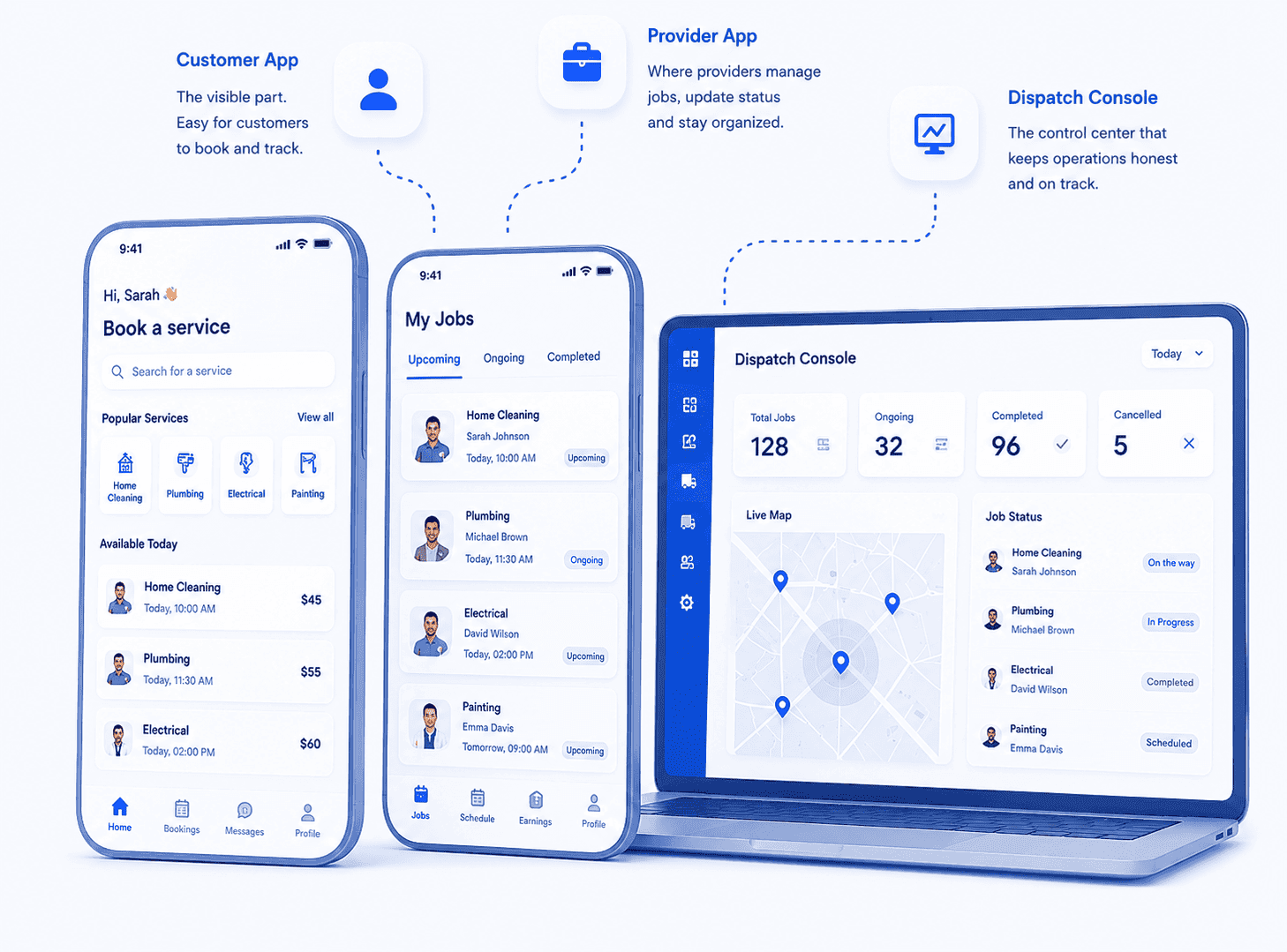
The Product
A booking app is really three products
The customer app is the visible part, and the easy part. Behind it sits a provider app where the actual work gets managed, and a dispatch console where someone keeps the operation honest when reality diverges from the schedule.
Customer appThe visible part
Provider appWhere work gets managed
Dispatch consoleWhere reality gets corrected
Treat the provider side as an afterthought and it fails predictably — providers keep using WhatsApp, the data stops reflecting reality, and the customer app starts showing availability that does not exist.
Build time
12–16 weeks
Team
4 engineers
Stack
React Native · Node · PostgreSQL
Includes
Customer + provider + admin
Payments
Stripe, or your gateway
Where manual booking breaks
Four things that cap your bookings
Bookings still arrive by phone
Someone takes the call, checks a calendar, phones a technician to confirm, then calls the customer back. Four touchpoints for one appointment, and none of them happen after 6pm.
Self-service booking against real availability, any hour
Dispatch is a whiteboard
Assigning jobs depends on one coordinator’s memory of who is where and who is good at what. When they are on leave, the operation runs noticeably worse.
Rules-based matching on skill, location, availability, and rating
Customers chase for updates
Between booking and arrival the customer has no idea what is happening. Every "is he still coming?" call is one your team has to answer, and one signal that the experience feels unmanaged.
Status notifications and live tracking from assignment to completion
Nothing signals trust
A stranger is coming to a customer’s home. Without verified profiles, ratings, and a named person with a photo, price becomes the only thing they can judge you on.
Verified provider profiles with credentials, photos, and real reviews
What We Build
Three connected products, one system
Customer app
Browse services, see real availability, pick a slot, track the provider en route, pay in-app, and rate afterwards. Rebooking a previous provider takes two taps.
- Service catalog & pricing
- Real-time slot availability
- Live job tracking
- Saved addresses & payment
Provider app
Accept or decline jobs, navigate to the address, update status at each stage, capture proof of completion, and see earnings without asking the office.
- Job offers with accept window
- Turn-by-turn navigation
- Status & photo capture
- Earnings & payout history
Admin console
The dispatch and oversight layer — live job board, manual reassignment, provider onboarding and verification, pricing rules, and the reporting that runs the business.
- Live dispatch board
- Provider vetting workflow
- Pricing & commission rules
- Revenue & SLA reporting
Matching Engine
Deciding who gets the job
This is the part that separates a booking form from an on-demand platform. Get it wrong and your best providers take all the work, the rest churn, and coverage collapses.
Skill and certification matching per service type
Distance and travel-time weighting from current location
Availability against confirmed schedule, not guesswork
Rating and completion-rate weighting
Load balancing so work spreads across the roster
Accept windows with automatic fallback to the next provider
Manual override from the dispatch console at any point
Recurring bookings pinned to a preferred provider
Marketplace vs Your Own
Renting demand vs owning it
Booking flow
Request form, confirmed later by phone
Real availability, confirmed instantly
Dispatch
Manual assignment by a coordinator
Rules-based matching with manual override
Customer updates
Customer calls to ask
Push notifications and live tracking
Provider tools
Phone calls and a group chat
Dedicated app with navigation and proof capture
Commission
Marketplace takes a cut of every job
Your platform, your margin
Customer data
Belongs to the marketplace
Yours, with repeat-booking history
How We Work
From phone bookings to two app stores
Map the service model
Service types, pricing rules, duration estimates, and how jobs actually get assigned today. The dispatch logic is the part that needs the most thought before build.
Design three experiences
Customer, provider, and admin have genuinely different needs. We prototype each and validate with real providers before writing production code.
Build and integrate
Apps, backend, matching engine, payments, and notifications built in parallel. Providers test on real devices from around week seven.
Pilot then scale
A soft launch in one area or one service line, with dispatch watched closely, before opening the full catalog. Store submission handled end to end.
Why Ethersofts
Why service businesses choose us
Matching is the hard part
Anyone can build a booking form. Deciding who gets the job, in what order, with what fallback, is where an on-demand platform succeeds or stalls.
Trust designed in
Verification workflow, credential expiry, photo profiles, and review moderation — because a stranger entering a home is the real conversion barrier.
One codebase, both stores
React Native across iOS and Android, with native modules where location and background tracking demand them.
Payments that fit the model
Pre-auth, capture on completion, split payouts to providers, tips, refunds, and cancellation rules — all handled properly.
Built for repeat business
Recurring schedules, preferred providers, and saved details, because the second booking is where the economics turn positive.
Yours to run
Full source, your store accounts, your payment relationship, your customer data. No marketplace clipping every transaction.
“They rebuilt our storefront headless with sub-second pages, smart search, and a checkout that just works. Conversion lifted, cart abandonment dropped, and Black Friday held without a hiccup.”
PS
Priya Sharma
Head of Growth · Zestify Commerce · Mumbai, India
FAQ
Booking app development, answered
If your question isn't here, ask it. You'll get a real answer from an engineer within 24 hours — not a sales pitch.
A booking app lets customers browse services, see genuine availability, and confirm an appointment without a phone call. For on-demand services it typically comes as three connected products: a customer app, a provider app for the people doing the work, and an admin console for dispatch and oversight.
Two apps and a web console is the usual shape. Customers and providers need different apps — the workflows barely overlap and combining them makes both worse. The admin side works better as a responsive web console, since dispatch is a desk activity and needs screen space.
A rules engine ranks available providers on skill and certification, distance or travel time, current availability, rating, and recent workload. The top match gets an accept window, and if they decline or time out it falls to the next. Dispatch can override manually at any point.
Twelve to sixteen weeks for customer app, provider app, admin console, matching engine, payments, and notifications. Store review adds one to two weeks at the end. A single-service pilot with a narrower catalog can launch closer to ten.
Yes — weekly cleans, monthly maintenance, or any custom cadence, with the option to pin a preferred provider so the customer gets the same person each time. Recurring work is usually where the unit economics of a services business actually improve, so it is worth building properly.
Typically pre-authorization at booking and capture on completion, so no-shows and cancellations are enforceable. Provider payouts run on your chosen schedule with commission deducted automatically. Stripe Connect covers most cases; we integrate regional gateways where it does not.
Yes. We prepare listings, assets, and privacy declarations, and manage the review process including the rejections that are routine for location-tracking apps. The developer accounts are registered in your name, so you retain control of the listings.
Yes. The same platform supports an employed workforce, a network of independent contractors, or a mix. Marketplace mode adds provider self-onboarding, document verification, commission handling, and payout schedules on top of the core booking flow.
Still taking bookings by phone?Let's Build The App

Let's Build The App
Your Customers Expect
Tell us your services and how jobs get assigned today. You'll get a written scope and a fixed quote within two working days.
Free consultation24-hour responseNDA on request