Compliance built inClient portal included4.7★ avg. rating
Workforce & Staffing Software Development
Employee Management Software Development
Custom systems covering the whole hire-to-placement lifecycle — candidate pipeline, interview scheduling, digital onboarding, and document compliance that blocks a start date when something has lapsed. No per-employee pricing.
S
H
R
C
Pipeline · Warehouse Operative · 12 roles
48
Applied
22
Screened
11
Interview
5
Offer
3
Placed
Candidate #4182Docs verified
Candidate #4177Permit expires in 21 days
Candidate #4165Onboarding pack signed
Time to fill9 days
Compliance100%
Active218
Auditable
Role-scoped
Client-visible
Candidate PipelineInterview SchedulingPlacement TrackingDigital OnboardingDocument ComplianceEmployee RosterTimesheetsClient PortalExpiry AlertsRole-Based AccessAudit TrailPayroll ExportCandidate PipelineInterview SchedulingPlacement TrackingDigital OnboardingDocument ComplianceEmployee RosterTimesheetsClient PortalExpiry AlertsRole-Based AccessAudit TrailPayroll Export
12 wks
Typical build to launch
End-to-end
Hire-to-placement coverage
0
Per-seat license fees
4.7★
Average client rating
The System
One person, one record, start to finish
Employee management software follows someone across their entire relationship with your business — application to offboarding — instead of scattering them across four tools.
Apply
Screen
Interview
Offer
Onboard
Place
Offboard
Workforce · Employee recordLive
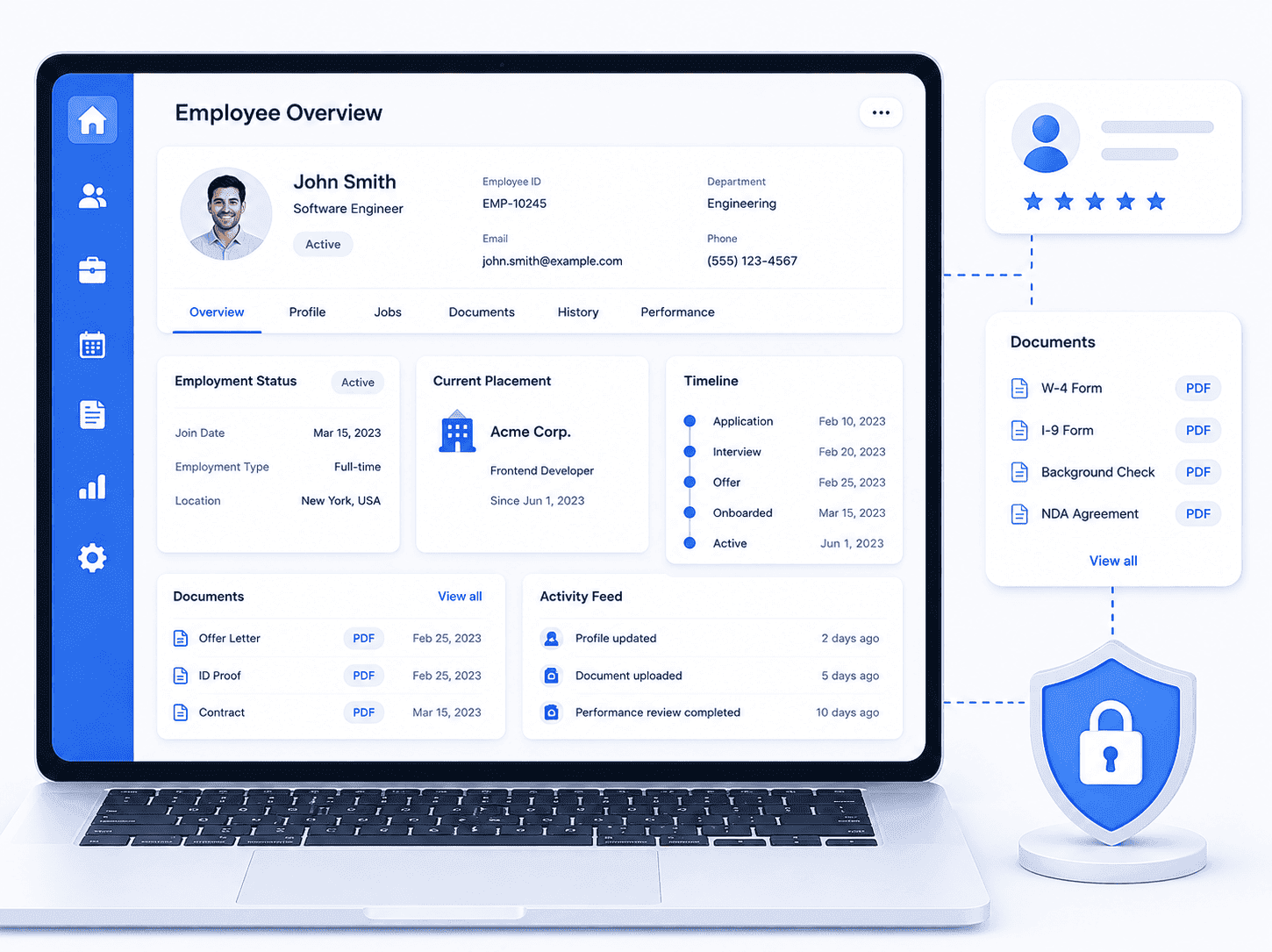
One record per person
Application through offboarding on a single timeline you can actually read.
Documents that block
Permits and certifications verified — and enforced — before day one.
Client-scoped views
Every client sees their own roles, live, and nothing else.
The long tail covered
Extensions, redeployment, rate changes and timesheets stay in place.
Permanent-staff HR tools
- One employer, one stable relationship
- Leave, payroll, appraisal cycles
- Documents stored, never enforced
Contract & staffing workforces
- Placements against specific clients
- Rate cards, extensions, redeployment
- Compliance checked before site access
Build time: 12–16 weeksTeam: 3–4 engineersStack: React · Node · PostgreSQLIntegrates with: Payroll, job boards, e-signAccess model: Role-based, org-chart mapped
Where spreadsheets fail
The four problems that trigger a rebuild
Compliance depends on one person remembering
Work permits expire, certifications lapse, and right-to-work documents sit in an inbox somewhere. Nobody finds out until an audit, or until a placement gets pulled on the client’s site.
Document expiry tracking with automated alerts weeks before the deadline
No single view of a person
Candidate data lives in one spreadsheet, placement details in another, and post-placement admin in email. Reconstructing someone’s history means opening four files and asking two colleagues.
One record per person spanning application through active placement
Coordination eats the week
Interview scheduling, availability checks, client confirmations, and start-date changes are all handled by hand. Recruiters spend more time arranging than recruiting.
Automated scheduling, status notifications, and client-side confirmation
Clients keep asking for updates
Every client wants to know where their roles stand, so someone builds a status email each week. The information already exists — it just is not anywhere the client can see it.
Client portal showing live pipeline status for their roles only
Lifecycle
Application to offboarding, one record
Most tools cover two or three of these stages well and hand the rest back to email. The gaps are where the administrative time actually goes.
Sourcing
Candidate intake
Applications from job boards, referrals, and direct upload land in one pipeline with parsed CVs, skill tagging, and duplicate detection.
Screening
Assessment & shortlisting
Structured screening notes, scorecards, and stage gates so two recruiters evaluate the same role the same way.
Interview
Scheduling & feedback
Availability matching across candidate, recruiter, and client, with automated invites and structured feedback capture.
Offer
Placement confirmation
Offer generation, client sign-off, rate confirmation, and start-date locking — with every change tracked.
Onboarding
Document collection
Digital onboarding packs, e-signature, right-to-work checks, and certification upload with validation before day one.
Active
Workforce administration
Roster management, timesheets, extensions, redeployment, and offboarding — the long tail most systems ignore.
Compliance
The part that carries real risk
A lapsed permit or an expired certification is not an admin inconvenience. It is a pulled placement, a failed audit, and sometimes a lost client.
Document type rules configured per role and per client
Automatic expiry alerts at 90, 30, and 7 days
Blocking rules — no placement start without valid documents
Right-to-work and certification verification workflows
Version history on every uploaded document
Encrypted storage with role-scoped access control
Audit export covering who accessed which record and when
Configurable retention and deletion schedules
HRMS vs Custom
Where an off-the-shelf HRMS runs out
Scope
HR admin for permanent staff only
Full hire-to-placement lifecycle including contractors
Client visibility
None — clients email for updates
Scoped portal per client, live pipeline status
Compliance
Document storage, no expiry logic
Expiry alerts and placement-blocking rules
Workflow
Fixed stages you adapt to
Your stages, your gates, your terminology
Cost model
Per employee, per month, forever
Fixed build, unlimited records
Data
Vendor-hosted, export on request
Your database, your cloud, direct access
How We Work
From scattered files to one system
Map the lifecycle
We document every stage a person passes through, from first application to offboarding, including the exceptions your team handles informally today.
Model compliance
Document requirements, expiry rules, and blocking conditions are defined per role and client before build starts — this is the part that carries real risk.
Build in sprints
Pipeline, scheduling, onboarding, and the client portal ship in parallel. Recruiters are testing against real roles from around week six.
Migrate and launch
Existing candidate and placement records imported and reconciled, permissions mapped to your org chart, team trained, then a phased cutover.
Why Ethersofts
Why staffing firms choose us
Compliance is not a folder
Expiry rules, blocking conditions, and audit trails are modeled as logic, not as a place to upload PDFs and hope.
Built for contract workforces
Extensions, redeployment, multi-client placement, and rate changes are first-class — not bolted onto a permanent-staff HR tool.
Clients get their own view
Scoped access means a client sees their roles and nothing else, which ends the weekly status email permanently.
Reporting that answers questions
Time-to-fill by role, drop-off by stage, placement duration, and compliance exposure — segmented however you need.
Access control done properly
Role-based permissions mapped to your actual org chart, with an access log you can hand to an auditor.
Yours to maintain
Full source, documentation, and a hand-over session. No per-employee pricing that punishes you for growing.
“They built our SaaS from scratch — auth, billing, dashboards, the works. Running 14 months with 99.97% uptime. When we needed features, the code was so clean changes were fast.”
JM
James Morton
CEO · Docket Analytics · Vancouver, Canada
FAQ
Employee management software, answered
If your question isn't here, ask it. You'll get a real answer from an engineer within 24 hours — not a sales pitch.
Employee management software tracks a person across their whole relationship with your organization — recruitment, onboarding, active employment or placement, and offboarding. Unlike a payroll or HR-admin tool, it covers the operational workflow around each person, including document compliance, scheduling, and client-facing status where relevant.
An HRMS is generally built for permanent staff at a single employer: leave, payroll, appraisals. A staffing or contract workforce needs something different — candidate pipelines, client-specific placements, rate cards, extensions, redeployment, and document compliance that blocks a start date. We build for that shape, and integrate with your HRMS or payroll rather than replacing it.
Twelve to sixteen weeks for the full lifecycle: pipeline, scheduling, placement management, onboarding with document compliance, workforce administration, and a client portal. A narrower first release focused on one or two stages can launch in eight. You get a working staging environment from around week six.
Yes, and it is usually the highest-value feature. Required document types are configured per role and per client, with automated alerts at 90, 30, and 7 days before expiry. Blocking rules can prevent a placement from starting when a mandatory document is missing or lapsed, which is what protects you in an audit.
Yes. Each client gets a scoped portal showing only their own roles, candidates at each stage, and placement status. In practice this removes most of the inbound "any update?" traffic, because the answer is already visible and current.
Typically yes. Common integrations are payroll export for timesheet and placement data, job board posting and application ingest, e-signature providers for onboarding packs, and calendar systems for interview scheduling. We build against the specific systems you already use.
Employee and candidate records are sensitive by definition. We build with encrypted storage, role-scoped access, full access logging, and configurable retention and deletion schedules so you can satisfy GDPR, PIPEDA, or the equivalent in your jurisdiction. The data stays in your cloud account.
No. It is a fixed-cost build and you own the result, so adding records or users costs nothing. Per-employee pricing is the reason most growing staffing firms come looking for a custom system in the first place — the bill scales exactly as fast as the business.
Running your workforce on spreadsheets?Let's Build The System
Let's Build The System
Your Team Deserves
Tell us how you track people today and where it breaks. You'll get a written scope and a fixed quote within two working days.
Free consultation24-hour responseNDA on request