Multi-tier approvalsClient acceptance portal4.7★ avg. rating
Quote & CPQ Software Development
Quote Management Software Development
Custom quoting systems that carry a deal from first line item to signed acceptance — with the approval chain your business actually runs on, and a client portal that replaces the PDF-by-email ritual. No per-seat license. You own it.
3
P
L
M
QT-2291 · Freight quote · $48,200
1
Quote drafted
Rep
2
Margin check
Auto
3
Manager sign-off
R. Mehta
4
Finance review
Finance
5
Sent to client
Portal
Margin22.4%
Discount8%
Cycle1.2 days
Versioned
Auditable
Portal-ready
Quote BuilderMulti-Tier ApprovalsClient PortalE-SignatureVersion HistoryMargin GuardrailsRate CardsCPQ RulesConversion AnalyticsCRM SyncPDF GenerationAudit TrailRole-Based AccessQuote BuilderMulti-Tier ApprovalsClient PortalE-SignatureVersion HistoryMargin GuardrailsRate CardsCPQ RulesConversion AnalyticsCRM SyncPDF GenerationAudit TrailRole-Based Access
10 wks
Typical build to launch
100%
Quote lifecycle covered
125+
Countries in one deployment
4.7★
Average client rating
The System
What quote management software does
It takes a quote from a structured builder, routes it through whatever internal sign-off your pricing demands, delivers it to the client somewhere they can act on it, and keeps a complete record of every version and decision along the way.
Most teams do not lose deals because their prices are wrong. They lose them because the quote took four days to leave the building. The generation step is easy — it is the approval chain and the client hand-off where time actually disappears.
- Build time
- 10–14 weeks
- Team
- 3–4 engineers
- Stack
- Next.js · Node · PostgreSQL
- Integrates with
- CRM, ERP, accounting
- Deployment
- Your cloud or ours
Quote lifecycle · QT-25041Approved
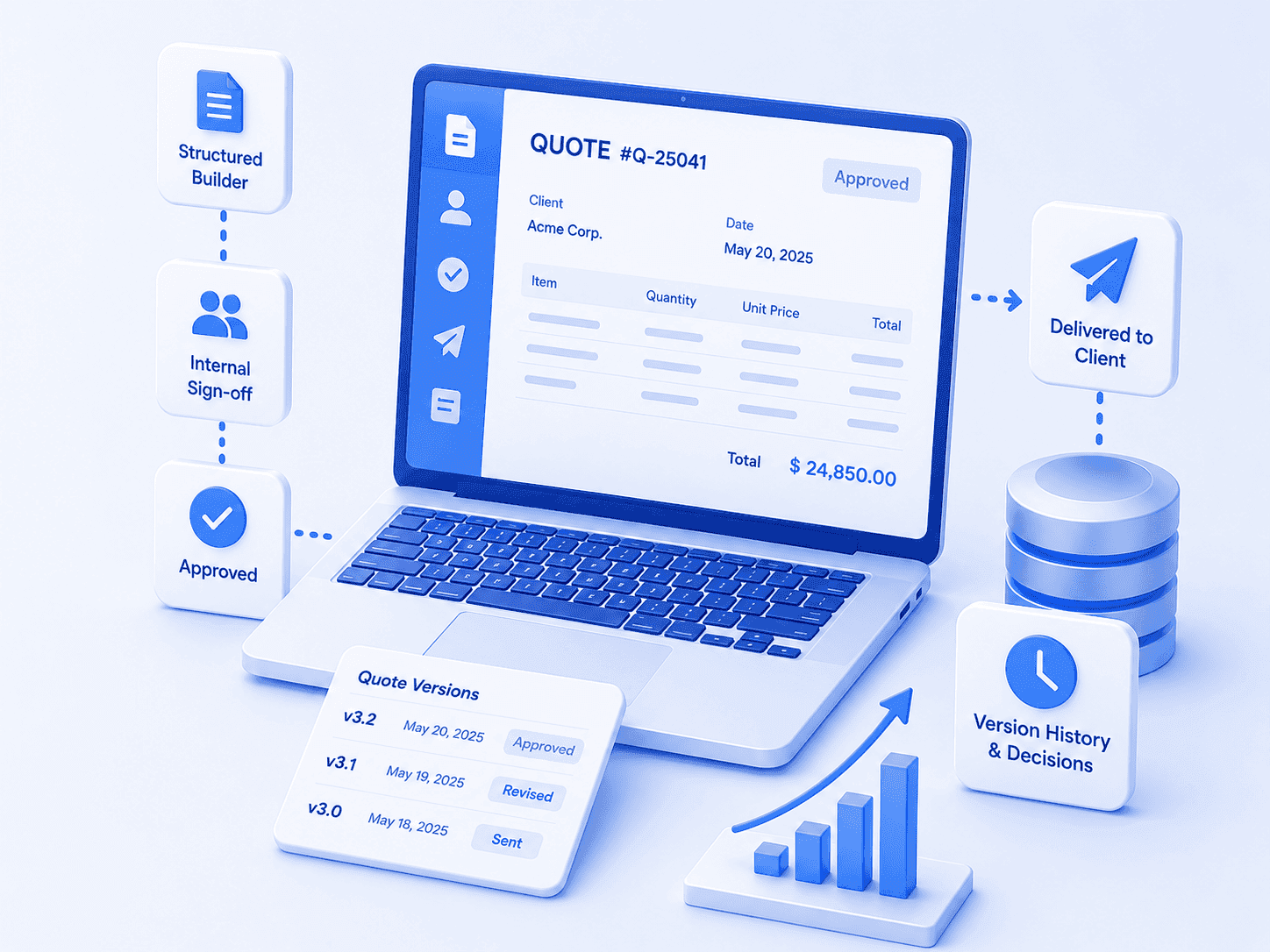
01Build
Line items from live rate cards
02Approve
Routed by value, discount, tier
03Deliver
Branded portal, not a PDF
04Record
Every version kept and diffable
Where quoting breaks
Four failures that cost you deals
Quotes take days, not minutes
A rep rebuilds the same spreadsheet for the fifth time this week, chases a manager for a discount sign-off, then emails a PDF that immediately goes stale. The deal cools while the paperwork catches up.
Structured quote builder with rate cards and reusable line-item templates
Approvals live in someone’s inbox
Anything past standard pricing needs a sign-off, but the rule exists only in people’s heads. Some quotes get three approvals, some get none, and nobody can prove which is which six months later.
Threshold-driven approval chains with a permanent, timestamped record
Margin leaks quietly
Discounting happens deal by deal with no ceiling. By quarter end the average margin has slipped several points and no single quote looks like the culprit, because none of them is.
Hard floors and soft warnings enforced at the line-item level
You cannot see what converts
Won and lost quotes sit in separate folders. Nobody can answer which lane, product, or rep actually converts, so pricing strategy stays a matter of opinion rather than evidence.
Conversion analytics segmented by client, product, lane, and owner
What We Build
The full quote lifecycle, in one system
Structured quote builder
Line items pulled from live rate cards, with quantity breaks, surcharges, taxes, and currency handled by the system rather than by whoever is fastest in a spreadsheet.
Rate cardsTemplatesMulti-currency
Multi-tier approval workflows
Routing driven by value, discount depth, client tier, or product mix. Parallel and sequential chains, delegation when someone is away, and full escalation rules.
Threshold rulesDelegationEscalation
Client-facing quote portal
Clients open a branded quote in the browser instead of a PDF attachment. They accept, request changes, or reject in place — and you see the moment they open it.
BrandedOpen trackingIn-place accept
E-signature and version history
Every revision is preserved and diffable. What was sent, who changed what, what the client actually signed — all recoverable, which matters when a dispute lands.
Diffable revisionsSigned copiesAudit trail
Automated follow-up
Reminders on unopened quotes, nudges before expiry, and internal alerts when an approval has been sitting too long. The chasing happens without anyone remembering to chase.
Expiry nudgesSLA alertsEmail + in-app
Conversion analytics
Win rate by client, product, region, and rep. Average discount by segment. Time-to-acceptance trends. The numbers that turn pricing from instinct into policy.
Win rateDiscount depthCycle time
Approval Engine
Sign-off that matches how you actually decide
A worked example. Your tiers, thresholds, and approvers will differ — the point is that they get encoded once, then applied identically to every quote.
Tier
Triggered when
Approver
Target
Tier 0
Within the standard rate card
No approval — the rep sends it
Instant
Tier 1
Discount up to 10%, or value under threshold
Sales manager
Same day
Tier 2
Discount 10–20%, or a non-standard term
Regional lead + finance
1 business day
Tier 3
Below margin floor, or a strategic account
Finance director sign-off
2 business days
Every transition is timestamped and attributed. When a client disputes a price nine months later, the record of who approved what is a query, not an archaeology project.
Client Side
Stop attaching PDFs to emails
A PDF is a dead end. The client cannot act on it, you cannot tell whether they read it, and the version they forward internally is the one you can no longer change.
Branded quote view on your own domain
Accept, reject, or request changes in one click
Open and view tracking with timestamps
Threaded comments against specific line items
Attachment and supporting-document downloads
Automatic expiry with configurable grace periods
E-signature capture with a legally retained copy
Mobile-friendly — most quotes get opened on a phone
Integrations
Connected to the systems you already run
CRM
Push accepted quotes straight into the opportunity record — Salesforce, HubSpot, Zoho, or a custom CRM.
ERP & inventory
Validate availability and cost at quote time so you never price something you cannot deliver.
Accounting
Accepted quote becomes a draft invoice in Xero, QuickBooks, or your finance system without re-keying.
Identity
SSO through Google Workspace, Microsoft Entra, or Okta, with role-based permissions mapped to your org chart.
Off-the-Shelf vs Custom
When a generic quoting tool stops being enough
Approval logic
One-size template, or an add-on
Mirrors your actual sign-off matrix
Pricing rules
Flat catalog pricing
Rate cards, breaks, surcharges, margin floors
Client experience
PDF attached to an email
Branded portal with in-place acceptance
Analytics
Quote count and totals
Win rate and discount depth by any dimension
Integrations
Whatever the vendor supports
Built against your CRM, ERP, and finance stack
Per-seat cost
Grows every time you hire
Fixed build, unlimited internal users
How We Work
From spreadsheet to signed acceptance
Map the real workflow
We sit with your reps and approvers and document how quoting actually happens — including the shortcuts. That map, not an idealized version, becomes the spec.
Model pricing and rules
Rate cards, discount tiers, margin floors, and the approval matrix get modeled and validated against historical quotes before any interface work starts.
Build in sprints
Quote builder, approval engine, and client portal ship in parallel. Your team is quoting in a staging environment from around week five.
Migrate and launch
Historical quotes imported, integrations connected, users trained. We run alongside your old process until the numbers reconcile, then switch over.
Why Ethersofts
Why teams bring this build to us
Approvals are the hard part
Most quote tools treat sign-off as a checkbox. We model it as a workflow engine, because that is what it is.
Margin protection built in
Floors, warnings, and escalation triggers live in the pricing model rather than in a policy document nobody reads.
The client side matters
A quote your customer can act on in the browser converts faster than one they have to download, sign, scan, and email back.
It fits your stack
We build against the CRM and ERP you already run, rather than asking you to migrate to suit the software.
Everything is auditable
Every version, approval, and client action is timestamped and preserved — which is what saves you in a contested deal.
Yours to maintain
Full source, documentation, and a hand-over session. No per-seat license, no vendor dependency.
“Real-time fleet tracking, route optimization, and a driver app — all integrated with our ERP. On-time deliveries jumped and we cut fuel and idle costs within the first quarter.”
IS
Imran Sheikh
Director of Operations · TransCargo Logistics · Dubai, UAE
FAQ
Quote management software, answered
If your question isn't here, ask it. You'll get a real answer from an engineer within 24 hours — not a sales pitch.
Quote management software handles the full lifecycle of a sales quote: building it from structured pricing, routing it for internal approval, delivering it to the client, capturing their acceptance, and reporting on what converted. It replaces the usual mix of spreadsheets, email threads, and PDF attachments with one system that keeps a complete record.
CRM quoting modules generate documents well but model approvals poorly. They typically support a single approver and flat catalog pricing. If your sign-off depends on discount depth, margin floor, client tier, or product mix — or needs two people in parallel — you will hit the ceiling quickly. We build the approval engine your process actually requires and sync the outcome back to your CRM.
Ten to fourteen weeks for a full system: quote builder, approval engine, client portal, analytics, and one or two integrations. Complex pricing models with many rate cards and currencies sit at the upper end. You get a working staging environment from around week five, so feedback starts long before launch.
Yes. Rules can trigger on quote value, discount percentage, margin after discount, client tier, product category, contract length, or any combination. Chains run sequentially or in parallel, support delegation when an approver is away, and escalate automatically when someone sits on a request too long.
We migrate them. Historical quotes are imported with their status and value so your conversion analytics have history from day one rather than starting empty. Where data is in spreadsheets we write a one-off import that maps your columns and flags anything ambiguous for review.
Yes. Each quote gets a branded page on your domain where the client can accept, reject, or request changes, with e-signature capture where you need it. You see when it was opened and how long they spent on it, which is often the most useful signal your sales team gets all week.
That is usually the highest-value part of the build. Typical integrations validate cost and availability from the ERP at quote time, then push an accepted quote into accounting as a draft invoice. We build against your specific systems rather than offering a fixed connector list.
No. This is a fixed-cost build and you own the result, so internal seats cost nothing to add. That difference compounds — teams that outgrow per-seat quoting tools are the most common reason operators come to us in the first place.
Quoting still living in spreadsheets?Let's Build A System

Let's Build A System
That Closes Faster
Tell us how your quotes get approved today. You'll get a written scope and a fixed quote within two working days.
Free consultation24-hour responseNDA on request