Provably fair by designNo revenue share4.7★ avg. rating
Mines & Crash Game Development
Mines Game Development Company
We build provably fair Mines and crash-style casino games from scratch — with a seed lifecycle your players can verify themselves, and an operator dashboard that puts RTP, risk, and exposure back in your hands. You own the code. We take no cut.
M
C
P
D
4.7 average rating
Mines · Round in play
Provably fair
Multiplier
1.00×
Mines
3
Gems found
0
Cash out
Server seedHashed
Client seedPlayer-set
SettlementInstant
Verifiable
Instant payout
Mobile-first
Provably FairServer Seed HashingLive MultiplierAuto Cash-OutCrypto WalletsRTP ControlRisk EngineAffiliate SystemKYC / AMLWebSocketRedisNext.jsMulti-CurrencyWhite-LabelRound Audit TrailProvably FairServer Seed HashingLive MultiplierAuto Cash-OutCrypto WalletsRTP ControlRisk EngineAffiliate SystemKYC / AMLWebSocketRedisNext.jsMulti-CurrencyWhite-LabelRound Audit Trail
8 wks
Typical build to launch
100%
Source code ownership
0%
Revenue share taken
12+
Countries served
The Game
What a Mines game actually is
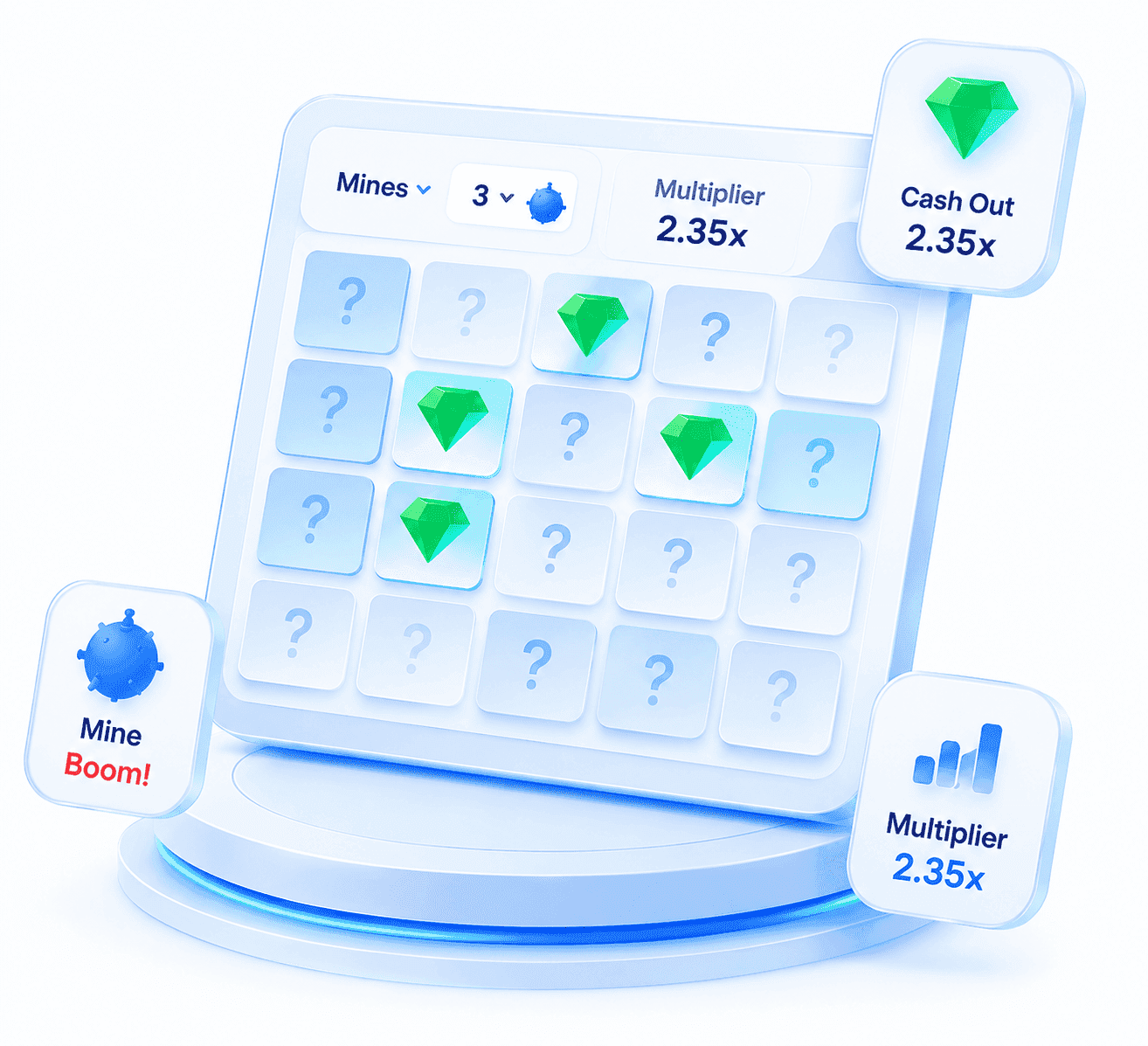
A single-player casino game on a 5×5 grid. The player picks how many mines are hidden, then reveals tiles one at a time. Hit a mine and the round is over — cash out first and the stake pays at whatever multiplier they stopped on.
01Set the risk
Player picks a stake and how many mines hide on the 5×5 grid.
02Reveal tiles
Every safe tile pushes the multiplier higher than the last one.
03Press or stop
One more tile is more money — or the round ending on the spot.
04Cash out
Stop first and the stake settles at whatever multiplier was live.
The maths is simple. What separates a game players return to from one they abandon is whether they believe the board was fixed before they touched it. That belief is not a marketing problem — it is an engineering one, and it is the part most Mines clones skip.
Mines · round in playProvably fair
Build time
8–10 weeks
Team
3–4 engineers
Stack
Next.js · Node · Redis
Fairness
Player-verifiable
Settlement
Crypto & fiat rails
Licensing
You hold it, we build to it
Why operators rebuild
What breaks with an off-the-shelf Mines
Every operator who has come to us for a custom build arrived with at least two of these.
Your RNG is a black box
Most white-label Mines titles never show how a round was generated. Players cannot check anything, so every unlucky streak turns into an accusation — and your support inbox pays for it.
A seed lifecycle any player can verify themselves, without trusting you
You cannot touch the RTP
Licensed game aggregators lock house edge and bet limits behind their own config. When margins move against you, there is nothing you can adjust and no one who answers quickly.
House edge, mine counts, and bet limits configurable from your own dashboard
Revenue share never stops
A 12–20% cut of gross gaming revenue looks small at launch and painful at scale. Two profitable years in, you have paid for the platform several times over and still own none of it.
Fixed build cost, full source ownership, no ongoing percentage
Rounds feel sluggish on mobile
Mines lives or dies on tap-to-reveal responsiveness. Polling-based clones add 300–600ms to every tile, and players quietly leave for a game that reacts instantly.
WebSocket round state with optimistic reveals and sub-100ms feedback
What We Build
Everything a Mines game needs to run for real money
Not a demo build. These are the systems that separate a weekend clone from a game you can put a license and a marketing budget behind.
Provably fair engine
Hashed server seed committed before the round, client seed supplied by the player, nonce incremented per bet. The seed is revealed at settlement so the mine layout can be reproduced independently.
HMAC-SHA256Seed rotationVerifier page
Player-verifiableLive multiplier & cash-out
Multipliers recalculate on every safe tile against remaining mines. Cash-out is server-authoritative, so a dropped connection mid-round settles correctly instead of vanishing.
WebSocketAuthoritativeReconnect-safe
Sub-100msAuto-bet & auto-cash-out
Rule-driven sessions — stop on profit, stop on loss, martingale steps, fixed tile patterns. This is what keeps high-volume players on your game instead of a competitor’s.
StrategiesLoss limitsSession caps
Retention driverWallets & instant settlement
Deposits and payouts over crypto rails, fiat gateways, or both. Balances are held in a ledger with double-entry accounting, so every cent is traceable to a round.
USDTBTCFiat gateways
Ledger-backedAffiliate & referral system
Tracked links, tiered commission rates, and payout schedules. Affiliates get their own dashboard rather than emailing you for numbers every Monday.
Tiered ratesSub-affiliatesAuto payouts
Growth built inCompliance controls
KYC/AML hooks, geo-fencing, self-exclusion, deposit limits, and session reminders. Built to slot into whichever jurisdiction you are licensed in, not hard-wired to one.
KYC / AMLGeo-fencingResponsible play
Regulator-readyThe Engine
How provably fair actually works
Five steps. If a vendor cannot walk you through all five for their game, it is not provably fair — it is marketing.
01
Server seed is generated and hashed
Before you place a bet, the server generates a random seed and shows you its SHA-256 hash. The seed itself stays hidden — but the hash is a commitment that cannot be changed later.
02
You supply your own client seed
The player sets a client seed, or accepts a random one. Because the operator cannot know it in advance, no mine layout can be pre-arranged against a specific player.
03
Mine positions are derived, not chosen
Server seed + client seed + nonce run through HMAC-SHA256. The output deterministically places the mines. Nothing about the layout responds to how you play the round.
04
The seed is revealed at settlement
When the round ends or the seed pair is rotated, the original server seed is published. Anyone can hash it and confirm it matches the commitment made before the bet.
05
Anyone can reproduce the result
We ship a verifier page and publish the algorithm. A player — or a regulator — can re-run the calculation offline and get the same board. That is the whole point.
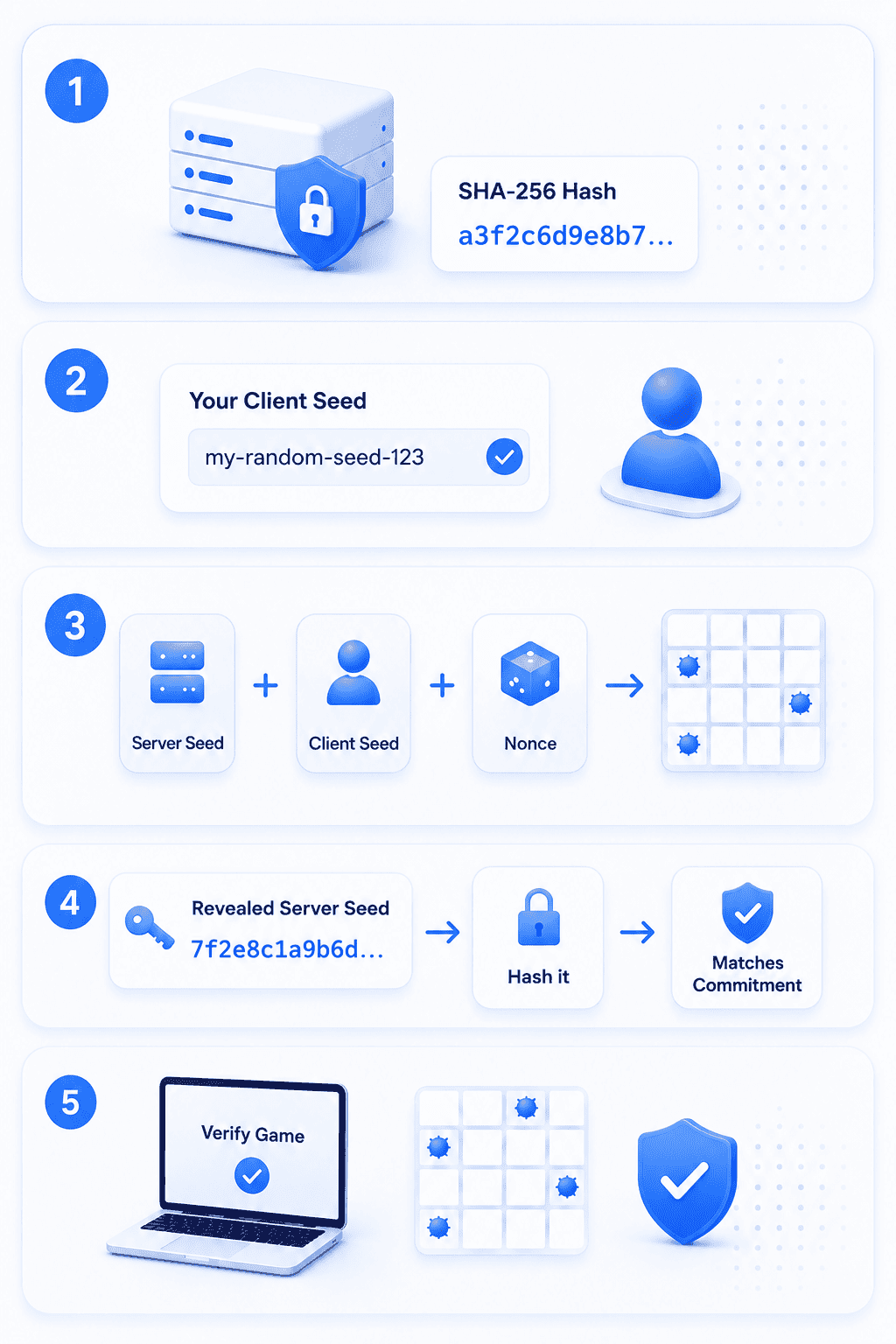
We publish the algorithm and ship a verifier page. Players do not have to take your word for anything.
Back Office
The dashboard is the product
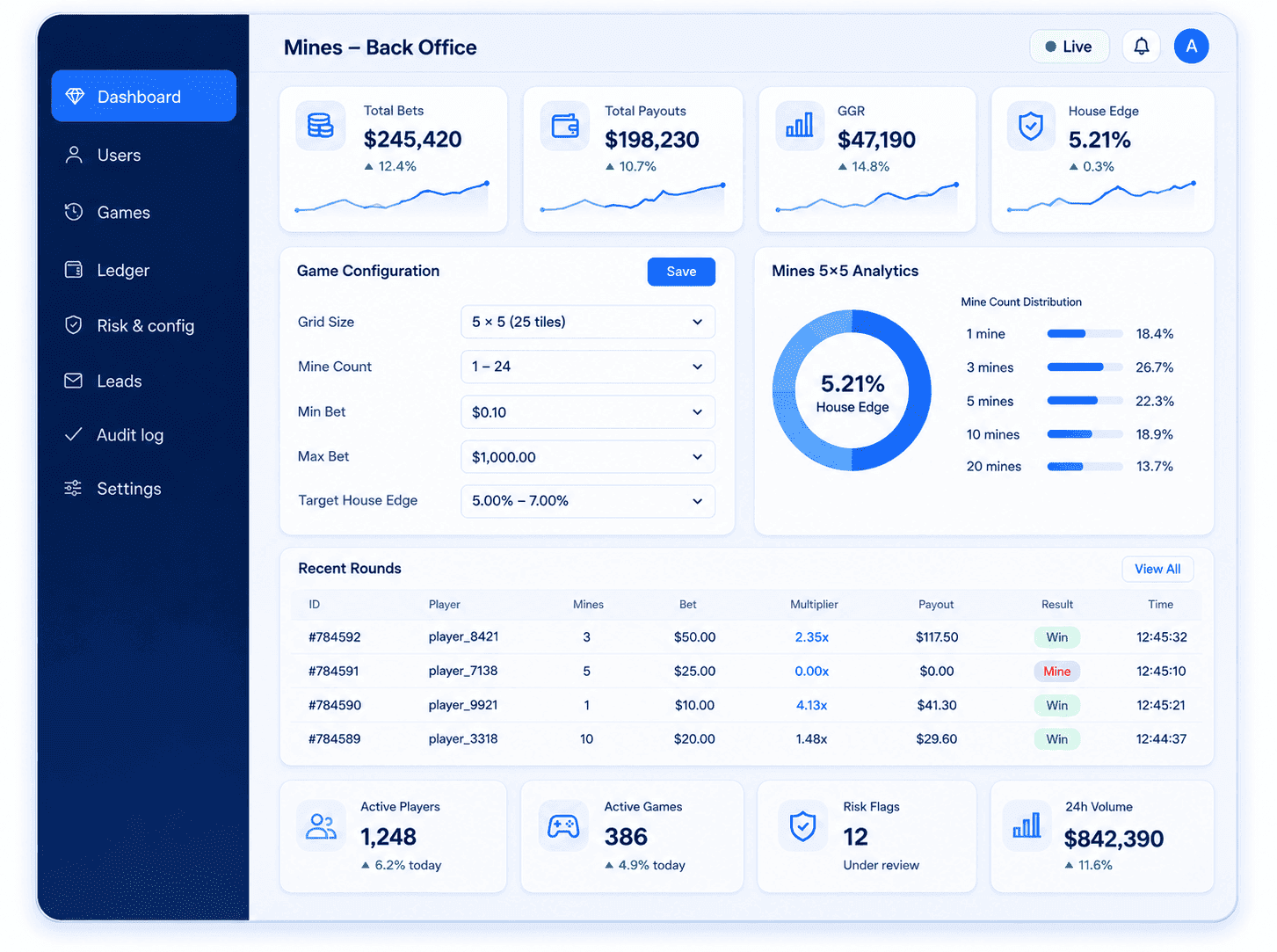
Players see a grid. You run a business. The operator console is where margin actually gets managed — and it is the half of the build that most Mines vendors treat as an afterthought.
- House edge and RTP tuning per game mode
- Grid size, mine count, and bet limit configuration
- Live exposure and liability monitoring
- Per-player round history with full audit trail
- Deposit, withdrawal, and manual adjustment logs
- Fraud flags — bonus abuse, multi-accounting, collusion
- Segmented player CRM and bonus campaigns
- Revenue, GGR, and cohort retention reporting
Every configuration change is versioned and logged, so you can always answer what the game was paying on a given date.
Build vs Rent
White-label Mines vs a custom build
Renting is faster to launch. Owning is cheaper by year two and better on every axis that affects retention.
Factor
White-label
Custom build
RNG transparency
Closed — players take it on trust
Open algorithm with a public verifier
RTP and house edge
Fixed by the provider
Configurable from your dashboard
Commercials
12–20% of gross gaming revenue, forever
Fixed build cost, no revenue share
Source code
Licensed, never owned
Yours, in your repository
Branding
Skin-deep theming only
Every pixel and interaction is yours
New features
Provider roadmap, provider timeline
Your backlog, shipped in sprints
Player data
Sits with the provider
Your database, your cloud
Beyond Mines
One engine, a whole game lobby
These titles share the same fairness engine, wallet, and back office. Commission them together and you pay for the hard part once.
Flagship
Mines
The classic 5×5 grid with configurable mine counts and a rising multiplier.
High volume
Crash / Aviator
A rising curve players must exit before it breaks, with live bet feeds.
Casual
Plinko
Physics-driven drops across configurable risk rows and payout buckets.
Low latency
Dice & Limbo
Roll-under and target-multiplier betting with instant round resolution.
Session length
Tower & Hi-Lo
Step-based progression games that share the same fairness engine.
Broad appeal
Keno & Wheel
Draw-based games with configurable paytables and jackpot logic.
Building a full lobby? Start with our gaming software development services, or read about blockchain development if you are settling on-chain.
How We Work
From payout table to live game
Eight to ten weeks, four stages, and a playable build in your hands well before the end.
Scope & maths
We agree the game modes, target RTP, and payout curve, and map your licensing jurisdiction. You get a fixed-price plan and a payout table you can model against — before any code.
Engine first
The fairness engine and round lifecycle get built and tested before the interface exists. Fairness bolted on afterwards is how most clones end up unverifiable.
Game & dashboard
Mobile-first gameplay and the operator back office are built in parallel sprints, with a playable build in your hands from week three onward.
Audit & launch
Load testing, payout-maths review, and a security pass — then a soft launch on your infrastructure with 30 days of hands-on support.
Engagement
Three ways to work with us
All three are fixed-fee or fixed-rate. None of them take a share of what your game earns.
Fixed-scope build
One game, one dashboard, one launch date. Best when you know the spec and want a predictable number.
- Fixed price, fixed timeline
- Milestone-based payments
- 30 days post-launch support
Platform build
Several games sharing one wallet, one fairness engine, and one back office. Cheaper per title than building each alone.
- Shared engine across games
- Unified wallet & CRM
- Add titles incrementally
Dedicated team
Engineers embedded with your team for continuous LiveOps and a moving roadmap.
- Monthly rolling contract
- Your backlog, your priorities
- Scale up or down monthly
Why Ethersofts
Why operators pick us to build it
Fairness is the architecture
The seed lifecycle is designed first and everything else is built around it — not patched in before launch.
No revenue share
You pay to build the game once. Every rupee, dollar, or satoshi it earns after that stays with you.
Your infrastructure
We deploy to your cloud accounts with your keys. There is no vendor kill-switch on your business.
Maths you can model
You get the payout table and edge calculations up front, so finance can sanity-check the game before it is built.
Mobile-first, browser-native
No app store review, no install friction. The game loads and plays on a mid-range phone over mobile data.
Built to be handed over
Documented code, runbooks, and a walkthrough with your engineers. Plenty of clients maintain it themselves after month two.
We build gaming software. We do not operate gaming sites, and we do not obtain licenses on your behalf — you hold the operating license for your jurisdiction, and we build to what it requires.
Technology
The stack behind the board
Chosen for round latency, settlement integrity, and the ability to hand the whole thing to your team later.

Next.js

React

TypeScript

Node.js

WebSocket

Redis

PostgreSQL

Solidity
Docker

Kubernetes

AWS

Cloudflare
“Multiplayer backend, real-time leaderboards, and a provably-fair engine — all battle-tested at scale. Ethersofts delivered a platform that stayed stable through our biggest tournament weekend.”
VN
Viktor Novak
CTO · Apex Play Studios · Singapore
FAQ
Mines game development, answered
If your question isn't here, ask it. You'll get a real answer from an engineer within 24 hours — not a sales pitch.
A Mines game is provably fair when the player can verify the result after the round instead of trusting the operator. The server commits to a hashed seed before the bet, the player contributes their own seed, and the mine positions are derived from both. When the server seed is revealed, anyone can re-run the hash and confirm the board was fixed before play began.
A single Mines game with a provably fair engine, wallet integration, and an operator dashboard typically takes 8 to 10 weeks with a team of three to four engineers. A multi-game platform sharing one wallet and one fairness engine runs 16 to 22 weeks depending on how many titles launch in the first release.
Yes, and that is the point. We ship a verifier page alongside the game and publish the algorithm. A player pastes the revealed server seed, their client seed, and the nonce, and gets the same mine layout back. No trust in the operator is required at any step.
Yes. House edge, grid size, mine count ranges, minimum and maximum bets, and per-mode payout curves are all configurable from the operator dashboard. Changes are versioned and logged, so you keep an audit trail of exactly what the game was paying at any point in time.
Yes. Crash and Aviator, Plinko, Dice, Limbo, Tower, Hi-Lo, Keno, and Wheel all run on the same fairness engine and wallet layer. Building them together is significantly cheaper per title than commissioning each one separately, because the hard part is shared.
Crypto settlement in USDT, BTC, ETH, and most major chains, plus fiat gateways where your jurisdiction allows them. Balances sit in a double-entry ledger rather than a single balance column, so every deposit, bet, win, and withdrawal reconciles against a specific round.
Completely. The code ships to your repository, deploys to your cloud accounts, and carries no license-back clause. We take no revenue share and no equity. If you want to maintain it in-house after launch, we run a handover with your engineers and hand over the runbooks.
We build to your jurisdiction’s requirements — KYC/AML hooks, geo-fencing, self-exclusion, deposit limits, and audit-ready reporting — but we do not obtain the license for you. You hold the operating license; we make sure the software satisfies what it demands.
Yes. Multi-tenant mode gives each sub-operator its own branding, domain, RTP configuration, and reporting, while the fairness engine and wallet stay centralized. It is a common setup for operators reselling to smaller partners.
A single Mines game with a dashboard typically lands in the mid five figures USD; a multi-game platform is higher and scoped per title. The number is fixed before we start and broken into milestone payments. Tell us the scope and you will have a written quote within two working days.
Planning a Mines or crash game?Let's Build A Game

Let's Build A Game
Players Can Verify
Send us your target RTP, jurisdiction, and launch window. You'll get a written scope and a fixed quote within two working days.
Free consultation24-hour responseNDA on request